> For the complete documentation index, see [llms.txt](https://www.pranaypourkar.co.in/the-programmers-guide/llms.txt). Markdown versions of documentation pages are available by appending `.md` to page URLs; this page is available as [Markdown](https://www.pranaypourkar.co.in/the-programmers-guide/interview-guide/technical/java-interview-companion/java-practice-programs/set-2-arrays.md).
# Set 2 - Arrays
## Integer
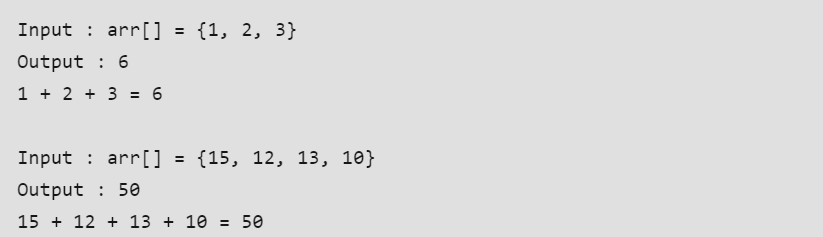
### Sum of Array Elements
#### Method 1: Using iteration
```java
int[] arr = {2,4,6,7,9};
int sum = 0;
for(int i=0; i
#### Method 1: Using iteration
```java
int[] arr = {2,4,6,7,9};
int max = Integer.MIN_VALUE;
for (int a : arr) {
if (max < a) {
max = a;
}
}
```
**Time Complexity:** O(n), where n represents the size of the given array.\
**Auxiliary Space:** O(1), no extra space is required, so it is a constant.
#### Method 2: Using streams
```java
int[] arr = {2,4,6,7,9};
int max = Arrays.stream(arr).max().getAsInt();
```
**Time Complexity:** O(n), where n represents the size of the given array.\
**Auxiliary Space:** O(1), no extra space is required, so it is a constant.
#### Method 3: Using manual sorting
Sorting the array using Insertion Sort and returning last element from the sorted array
```java
static int largest(int arr[],int n)
{
for (int i = 1; i < n; ++i) {
int key = arr[i];
int j = i - 1;
while (j >= 0 && arr[j] > key) {
arr[j + 1] = arr[j];
j = j - 1;
}
arr[j + 1] = key;
}
return arr[n-1];
}
```
**Time Complexity:** O(n logn), where n represents the size of the given array.\
**Auxiliary Space:** O(1), no extra space is required, so it is a constant.
#### Method 4: Using sorting via Arrays.sort(..)
```java
int[] arr = {8,4,6,7,9};
Arrays.sort(arr);
int max = arr[arr.length-1];
```
**Time Complexity:** O(n logn), where n represents the size of the given array.\
**Auxiliary Space:** O(1), no extra space is required, so it is a constant.
#### Method 5: Using Collections.max()
```java
int[] arr = {8,4,6,7,9};
int max;
// Convert array to arraylist via streams
List arrayList = new ArrayList<>(Arrays.asList(Arrays.stream(arr).boxed().toArray(Integer[]::new)));
max = Collections.max(arrayList);
// Convert array to arraylist manually iterating each array element
List list = new ArrayList<>();
for (int j : arr) {
list.add(j);
}
max = Collections.max(list);
```
### Array Rotation
#### Method 1: Using additional array
```java
for (int a=0; a
### Remove duplicate elements from an Array
**Input:** arr\[] = {2, 1, 2, 2, 3, 4, 4, 4, 5, 5}\
**Output:** arr\[] = {1, 2, 3, 4, 5}
#### Method 1: Using Set
```java
int[] arr = { 1, 2, 2, 3, 3, 3, 4, 5 };
System.out.println(Arrays.toString(arr));
// Using Set
Set set = new HashSet<>();
for (int element : arr) {
set.add(element);
}
// Convert set to array
int[] result = set.stream().mapToInt(Integer::intValue).toArray();
System.out.println(Arrays.toString(result));
```
**Time Complexity:** O(n) (iterating through the array once)\
**Auxiliary Space:** O(n) (to store unique elements in the Set)
#### Method 2: Using ArrayList
```java
int[] arr = { 1, 2, 2, 3, 3, 3, 4, 5 };
System.out.println(Arrays.toString(arr));
// Using ArrayList
List arrList = new ArrayList<>();
for (int element : arr) {
if (!arrList.contains(element)) {
arrList.add(element);
}
}
int[] result2 = arrList.stream().mapToInt(Integer::intValue).toArray();
System.out.println(Arrays.toString(result2));
```
**Time Complexity**: O(n^2) in the worst case (nested loop with contains() method)\
**Auxiliary Space**: O(n) (to store unique elements in the ArrayList)
#### Method 3: Using Sorting
Sort the array and use the approaches given below.
### Remove duplicate elements from a SortedArray
#### Method 1: Using Iteration and Sorting
```java
public class Application {
public static void main(String[] args) {
int[] arr = { 1, 2, 2, 3, 3, 3, 4, 5 };
System.out.println(Arrays.toString(arr));
int uniqueArraySize = removeDuplicates(arr);
for (int i=0; i
#### Method 1: Using iteration
```java
static int[] removeOccurrencesOfAnElement(int[] arr, int key) {
int i = 0;
for (int a : arr) {
if (a != key) {
arr[i++] = a;
}
}
return Arrays.copyOfRange(arr, 0, i);
}
```
**Time Complexity:** O(n)\
**Space Complexity:** O(n)
#### Method 2: Using Streams
```java
int[] result = Arrays.stream(arr)
.filter(num -> num != key)
.toArray();
```
* **Time Complexity**: O(n)
The `Arrays.stream(arr)` operation takes O(n) time, where n is the length of the input array `arr`. The `filter()` operation iterates through each element of the stream and applies the predicate `num -> num != key`. In the worst case, this operation also takes O(n) time. The `toArray()` operation collects the elements of the stream into an array, which takes O(n) time.
* **Space Complexity**: O(n)
The space complexity is O(n) because we are creating a new array to store the filtered elements. The size of this array is equal to the number of elements that pass the filter condition, which could be up to n elements in the worst case.
#### Method 3: Using List
```java
List arrList = IntStream.of(arr)
.boxed()
.collect(Collectors.toList());
int[] result = arrList.stream()
.mapToInt(Integer::intValue)
.filter(element -> element != key)
.toArray();
```
* **Time Complexity**: O(n)
Creating the list `arrList` from the array `arr` using `IntStream.of(arr).boxed().collect(Collectors.toList())` takes O(n) time, where n is the length of the input array `arr`. Remaining is same as above Method.
* **Space Complexity**: O(n)
## String
## Char
---
# Agent Instructions
This documentation is published with GitBook. GitBook is the documentation platform designed so that both humans and AI agents can read, navigate, and reason over technical content effectively. Learn more at gitbook.com.
## Querying This Documentation
If you need additional information that is not directly available in this page, you can query the documentation dynamically by asking a question.
Perform an HTTP GET request on the current page URL with the `ask` query parameter, and the optional `goal` query parameter:
```
GET https://www.pranaypourkar.co.in/the-programmers-guide/interview-guide/technical/java-interview-companion/java-practice-programs/set-2-arrays.md?ask=&goal=
```
`ask` is the immediate question: it should be specific, self-contained, and written in natural language.
`goal` is optional and describes the broader end goal you are ultimately trying to accomplish on behalf of the user. GitBook uses it to tailor the answer towards what is most useful for that goal.
The response will contain a direct answer to the question and relevant excerpts and sources from the documentation.
Use this mechanism when the answer is not explicitly present in the current page, you need clarification or additional context, or you want to retrieve related documentation sections.