> For the complete documentation index, see [llms.txt](https://www.pranaypourkar.co.in/the-programmers-guide/llms.txt). Markdown versions of documentation pages are available by appending `.md` to page URLs; this page is available as [Markdown](https://www.pranaypourkar.co.in/the-programmers-guide/spring/spring-features/inter-service-communication/rest-communication/webclient/openapi-generated-clients/use-case-internal-api-calls-with-openapi-clients.md).
# Use Case: Internal API Calls with OpenAPI Clients
## About
In a typical microservices architecture, services frequently need to communicate with each other to perform operations or retrieve data. This use case demonstrates how **OpenAPI-generated clients** can be used to make **internal service-to-service calls** in a Spring Boot-based system, ensuring:
* Strong typing and IDE support
* Reduced boilerplate
* Consistent request and response handling
* Alignment with the contract defined in OpenAPI specs
This setup uses two services:
* `account-service`: Exposes an endpoint to retrieve account details.
* `payment-service`: Calls the `account-service` using a client generated from `account-api-spec`.
Both services are aligned on their contracts using shared OpenAPI specifications and generate client code during build time using the **OpenAPI Generator** with the `spring-webclient` library.
## **Project Structure**
#### **Specs**
* **account-api-spec** Contains the OpenAPI definition (`account.yaml`) for retrieving account details.
* **payment-api-spec** Contains `payment.yaml` defining how to retrieve payment details.
#### **Service**
* **account-service** Implements the account API (as per spec) using Spring Boot.
* **payment-service** Depends on both API specs and uses OpenAPI-generated clients to call `account-service`.
## **1. account-api-spec**
**Structure**
```
account-api-spec/
├── assembly/api.xml
├── pom.xml
└── src/main/resources/openapi/account.yaml
```
**api.xml**
```xml
apizipfalsesrc/main/resources/openapiaccount.yaml/
```
**account.yaml**
```yaml
openapi: 3.0.3
info:
title: Account API
description: Account API Specification
version: 1.0.0
servers:
- description: local test
url: http://localhost:8080/api/v1
paths:
/api/v1/accounts/{id}:
summary: Get account details by ID
description: Get account details by ID
get:
operationId: getAccountById
parameters:
- name: id
in: path
required: true
schema:
type: string
responses:
'200':
description: Account found
content:
application/json:
schema:
$ref: '#/components/schemas/AccountResponse'
tags:
- Account
components:
schemas:
AccountResponse:
type: object
properties:
id:
type: string
name:
type: string
email:
type: string
balance:
type: number
format: double
createdAt:
type: string
format: date-time
```
**pom.xml**
```xml
4.0.0com.company.projectaccount-api-spec1.0.0jarorg.apache.maven.pluginsmaven-assembly-plugin3.7.1assemble-api-zipsinglepackageassembly/api.xml
```
**Build the package**
```
mvn clean install
```
## **2. payment-api-spec**
**Structure**
```
payment-api-spec/
├── assembly/api.xml
├── pom.xml
└── src/main/resources/openapi/payment.yaml
```
**api.xml**
```xml
apizipfalsesrc/main/resources/openapipayment.yaml/
```
**payment.yaml**
```yaml
openapi: 3.0.3
info:
title: Payment API
description: Payment API Specification
version: 1.0.0
servers:
- description: local test
url: http://localhost:8080/api/v1
paths:
/api/v1/payments/{id}:
summary: Get payment details by ID
description: Get payment details by ID
get:
operationId: getPaymentById
parameters:
- name: id
in: path
required: true
schema:
type: string
responses:
'200':
description: Payment found
content:
application/json:
schema:
$ref: '#/components/schemas/PaymentResponse'
tags:
- Payment
components:
schemas:
PaymentResponse:
type: object
properties:
id:
type: string
amount:
type: number
status:
type: string
account-id:
type: string
account-name:
type: string
```
**pom.xml**
```xml
4.0.0com.company.projectpayment-api-spec1.0.0jarorg.apache.maven.pluginsmaven-assembly-plugin3.7.1assemble-api-zipsinglepackageassembly/api.xml
```
**Build the package**
```
mvn clean install
```
## **3. account-service**
**Structure**
```
account-service/
├── .openapi-generator-ignore
├── pom.xml
├── src/main/java/com/company/project/controller/AccountController.java
├── src/main/java/com/company/project/AccountServiceApplication.java
└── src/main/resources/application.yaml
```
**.openapi-generator-ignore**
```
# OpenAPI Generator Ignore
# Generated by openapi-generator https://github.com/openapitools/openapi-generator
# Use this file to prevent files from being overwritten by the generator.
# The patterns follow closely to .gitignore or .dockerignore.
# Exclude unwanted files and directories
**/src/main/AndroidManifest.xml
**/build.sbt
**/pom.xml
**/gradle/
**/git_push.sh
**/.travis.yml
**/api/openapi.yaml
```
**pom.xml**
```xml
4.0.0org.springframework.bootspring-boot-starter-parent3.4.4com.company.projectaccount-service1.0.0jar21org.springframework.bootspring-boot-starter-weborg.projectlomboklombok1.18.36org.openapitoolsjackson-databind-nullable0.2.6io.swagger.core.v3swagger-annotations2.2.29jakarta.validationjakarta.validation-api3.1.1org.springframework.bootspring-boot-starter-testtestorg.apache.maven.pluginsmaven-dependency-plugin3.8.1unpack-openapi-specgenerate-sourcesunpackcom.company.projectaccount-api-spec1.0.0apiziptrue${project.build.directory}/generated-specs/account-api-spec**/*.yaml, **/*.jsonorg.openapitoolsopenapi-generator-maven-plugin6.6.0generate-spring-boot-server-codegeneratefalsespringtruefalsefalse${project.build.directory}/generated-specs/account-api-spec/account.yamlcom.company.project.client.account.v1.apicom.company.project.client.account.v1.modelspring-boottruetruetruetruefalsefalsetruetruefalse.openapi-generator-ignore
```
**AccountController.java**
```java
package com.company.project.controller;
import com.company.project.client.account.v1.api.AccountApi;
import com.company.project.client.account.v1.model.AccountResponse;
import lombok.extern.slf4j.Slf4j;
import org.springframework.http.ResponseEntity;
import org.springframework.web.bind.annotation.RestController;
@Slf4j
@RestController
public class AccountController implements AccountApi {
/**
* GET /api/v1/accounts/{id}
*
* @param id (required)
* @return Account found (status code 200)
*/
@Override
public ResponseEntity getAccountById(String id) {
var accountResponse = new AccountResponse()
.id(id)
.name("Sample Account")
.balance(1000.00);
return ResponseEntity.ok(accountResponse);
}
}
```
**AccountServiceApplication.java**
```java
package com.company.project;
import org.springframework.boot.SpringApplication;
import org.springframework.boot.autoconfigure.SpringBootApplication;
@SpringBootApplication
public class AccountServiceApplication {
public static void main(String[] args) {
SpringApplication.run(AccountServiceApplication.class, args);
}
}
```
**application.yaml**
```yaml
logging:
level:
root: DEBUG
server:
port: 8082
servlet:
context-path: /
```
**Build the package**
```
mvn clean install
```
## **4. payment-service**
**Structure**
```
payment-service/
├── .openapi-generator-ignore
├── pom.xml
├── src/main/java/com/company/project/client/AccountServiceRestClientConfig.java
├── src/main/java/com/company/project/controller/PaymentController.java
├── src/main/java/com/company/project/service/PaymentService.java
├── src/main/java/com/company/project/PaymentServiceApplication.java
└── src/main/resources/application.yaml
```
**.openapi-generator-ignore**
```
# OpenAPI Generator Ignore
# Generated by openapi-generator https://github.com/openapitools/openapi-generator
# Use this file to prevent files from being overwritten by the generator.
# The patterns follow closely to .gitignore or .dockerignore.
# Exclude unwanted files and directories
**/src/main/AndroidManifest.xml
**/build.sbt
**/pom.xml
**/gradle/
**/git_push.sh
**/.travis.yml
**/api/openapi.yaml
```
**pom.xml**
```xml
4.0.0org.springframework.bootspring-boot-starter-parent3.4.4com.company.projectpayment-service1.0.0jar21org.springframework.bootspring-boot-starter-weborg.springframework.bootspring-boot-starter-webfluxorg.projectlomboklombok1.18.36org.openapitoolsjackson-databind-nullable0.2.6io.swagger.core.v3swagger-annotations2.2.29jakarta.validationjakarta.validation-api3.1.1org.springframework.bootspring-boot-starter-testtestorg.apache.maven.pluginsmaven-dependency-plugin3.8.1unpack-openapi-specgenerate-sourcesunpackcom.company.projectaccount-api-spec1.0.0apiziptrue${project.build.directory}/generated-specs/account-api-speccom.company.projectpayment-api-spec1.0.0apiziptrue${project.build.directory}/generated-specs/payment-api-spec**/*.yaml, **/*.jsonorg.openapitoolsopenapi-generator-maven-plugin6.6.0generate-spring-boot-server-codegeneratefalsespringtruefalsefalse${project.build.directory}/generated-specs/payment-api-spec/payment.yamlcom.company.project.client.payment.v1.apicom.company.project.client.payment.v1.modelspring-boottruetruetruetruefalsefalsetruetruefalse.openapi-generator-ignoregenerate-spring-boot-client-codegeneratetruejavatruefalsefalsefalsefalse${project.build.directory}/generated-specs/account-api-spec/account.yamlcom.company.project.client.account.v1.apicom.company.project.client.account.v1.modelwebclientjava8truetruetruetruefalsefalsetrue.openapi-generator-ignore
```
**AccountServiceRestClientConfig.java**
```java
package com.company.project.client;
import com.company.project.client.account.v1.ApiClient;
import com.company.project.client.account.v1.api.AccountApi;
import org.springframework.beans.factory.annotation.Value;
import org.springframework.context.annotation.Bean;
import org.springframework.context.annotation.Configuration;
@Configuration
public class AccountServiceRestClientConfig extends ApiClient {
@Value("${services.account-service.base-path}")
private String basePath;
@Bean
public AccountApi accountApi() {
return new AccountApi(createApiClient());
}
private ApiClient createApiClient() {
return new ApiClient(buildWebClient())
.setBasePath(basePath);
}
}
```
**PaymentController.java**
```java
package com.company.project.controller;
import com.company.project.client.payment.v1.api.PaymentApi;
import com.company.project.client.payment.v1.model.PaymentResponse;
import com.company.project.service.PaymentService;
import lombok.RequiredArgsConstructor;
import lombok.extern.slf4j.Slf4j;
import org.springframework.http.ResponseEntity;
import org.springframework.web.bind.annotation.*;
@Slf4j
@RequiredArgsConstructor
@RestController
public class PaymentController implements PaymentApi {
private final PaymentService paymentService;
/**
* GET /api/v1/payments/{id}
*
* @param id (required)
* @return Payment found (status code 200)
*/
@Override
public ResponseEntity getPaymentById(String id) {
log.info("Request to get payment details for id: {}", id);
return ResponseEntity.ok(paymentService.fetchPaymentDetails(id));
}
}
```
**PaymentService.java**
```java
package com.company.project.service;
import com.company.project.client.AccountServiceRestClientConfig;
import com.company.project.client.payment.v1.model.PaymentResponse;
import lombok.RequiredArgsConstructor;
import org.springframework.stereotype.Service;
@RequiredArgsConstructor
@Service
public class PaymentService {
private final AccountServiceRestClientConfig accountServiceRestClientConfig;
public PaymentResponse fetchPaymentDetails(String id) {
var accountDetails = accountServiceRestClientConfig.accountApi()
.getAccountById("DUMMY_ACCOUNT_ID")
.block();
// Return dummy details for the sake of this example
return new PaymentResponse()
.id(id)
.amount(new java.math.BigDecimal("100.0"))
.status("COMPLETED")
.accountId(accountDetails.getId())
.accountName(accountDetails.getName());
}
}
```
**PaymentServiceApplication.java**
```java
package com.company.project;
import org.springframework.boot.SpringApplication;
import org.springframework.boot.autoconfigure.SpringBootApplication;
@SpringBootApplication
public class PaymentServiceApplication {
public static void main(String[] args) {
SpringApplication.run(PaymentServiceApplication.class, args);
}
}
```
**application.yaml**
```yaml
logging:
level:
com.example: DEBUG
root: DEBUG
server:
port: 8081
servlet:
context-path: /
services:
account-service:
base-path: "http://localhost:8082/"
```
**Build the package**
```
mvn clean install
```
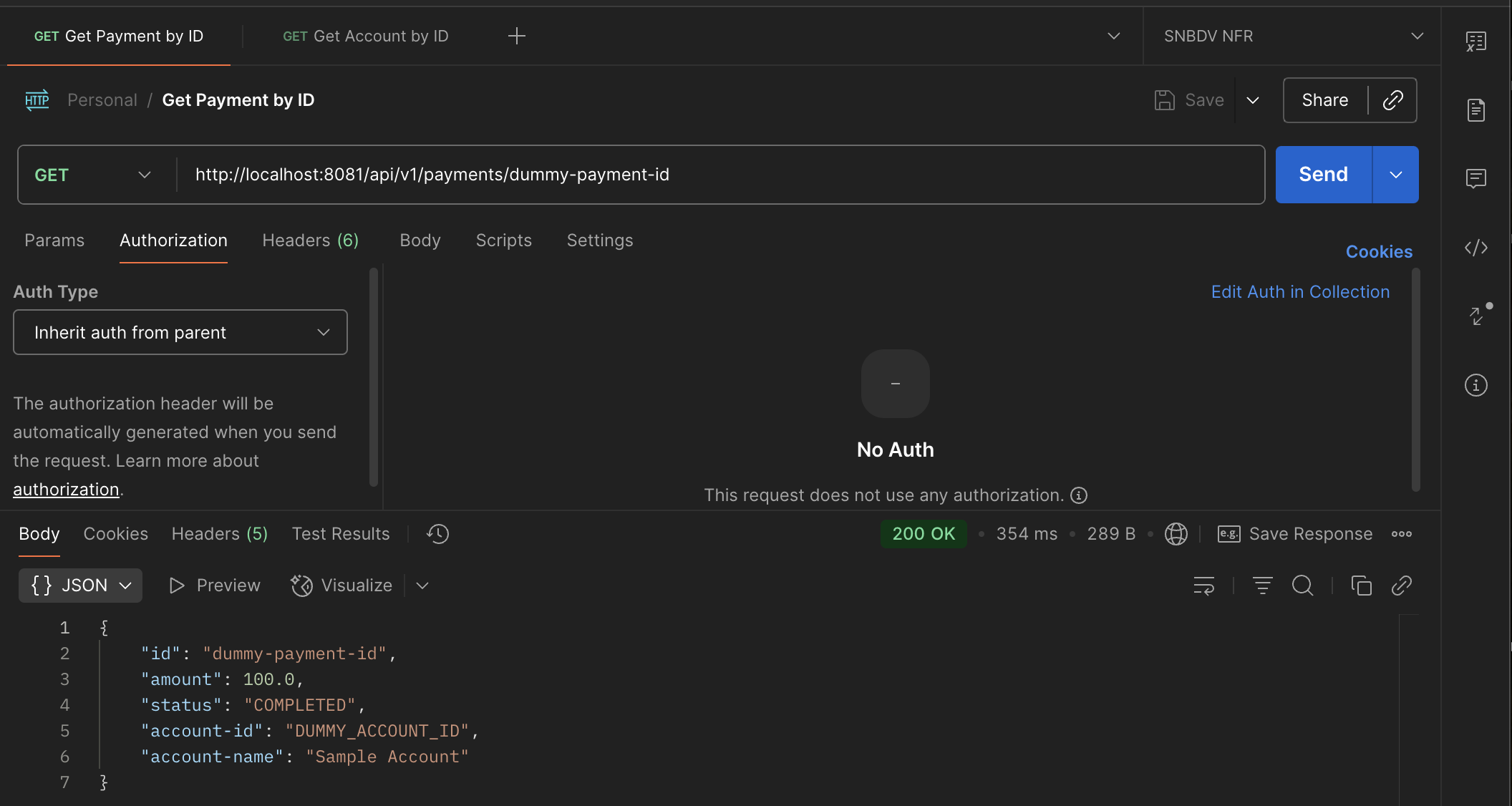
## Verification
Start both the services using `mvn spring-boot:run`
**Test the API with Postman**
## Reference
{% file src="/files/k57NdDOleSyTXyapnEjg" %}
---
# Agent Instructions
This documentation is published with GitBook. GitBook is the documentation platform designed so that both humans and AI agents can read, navigate, and reason over technical content effectively. Learn more at gitbook.com.
## Querying This Documentation
If you need additional information that is not directly available in this page, you can query the documentation dynamically by asking a question.
Perform an HTTP GET request on the current page URL with the `ask` query parameter, and the optional `goal` query parameter:
```
GET https://www.pranaypourkar.co.in/the-programmers-guide/spring/spring-features/inter-service-communication/rest-communication/webclient/openapi-generated-clients/use-case-internal-api-calls-with-openapi-clients.md?ask=&goal=
```
`ask` is the immediate question: it should be specific, self-contained, and written in natural language.
`goal` is optional and describes the broader end goal you are ultimately trying to accomplish on behalf of the user. GitBook uses it to tailor the answer towards what is most useful for that goal.
The response will contain a direct answer to the question and relevant excerpts and sources from the documentation.
Use this mechanism when the answer is not explicitly present in the current page, you need clarification or additional context, or you want to retrieve related documentation sections.