> For the complete documentation index, see [llms.txt](https://www.pranaypourkar.co.in/the-programmers-guide/llms.txt). Markdown versions of documentation pages are available by appending `.md` to page URLs; this page is available as [Markdown](https://www.pranaypourkar.co.in/the-programmers-guide/spring/spring-features/spring-aop/after-throwing-advice.md).
# After Throwing Advice
Details as well as Examples covering After Throwing Advice.
After throwing advice is executed after the target method throws an exception. It allows to handle or log exceptions thrown by the method. Some of the use cases are described below.
**Exception Logging**: It can be used to log exceptions and stack traces to diagnose errors and troubleshoot issues.
**Notification on Error**: Sending notifications or alerts to administrators or users about unexpected errors.
**Resource Cleanup**: Releasing resources, such as database connections or file handles, to prevent resource leaks.
**Transaction Rollback**: Can be used to close open transactions or rolling back database changes in response to exceptions.
#### Sample Example
#### Scenario 1: Capturing exception details via AOP
Create Aspect class
```java
package org.example.logging;
import lombok.extern.slf4j.Slf4j;
import org.aspectj.lang.JoinPoint;
import org.aspectj.lang.annotation.AfterThrowing;
import org.aspectj.lang.annotation.Aspect;
import org.springframework.stereotype.Component;
@Slf4j
@Aspect
@Component
public class LoggingAspect {
private static final String AFTER_THROWING_POINTCUT ="execution(* org.example.controller.*.*(..))";
@AfterThrowing(value = AFTER_THROWING_POINTCUT, throwing = "exception")
public void logsErrors(JoinPoint joinPoint, Throwable exception){
// Log the controller name
log.info("AfterThrowing - {}", joinPoint.getSignature().getName());
// Log the exception message
log.info("AfterThrowing - {}", exception.getMessage());
}
}
```
Create controller class. Assuming. some logic in the method throws exception.
***DataApi.java***
```java
package org.example.controller;
import lombok.RequiredArgsConstructor;
import lombok.extern.slf4j.Slf4j;
import org.example.Model.InputData;
import org.example.Model.OutputData;
import org.example.service.DataService;
import org.springframework.http.HttpStatus;
import org.springframework.http.ResponseEntity;
import org.springframework.web.bind.annotation.PostMapping;
import org.springframework.web.bind.annotation.RequestBody;
import org.springframework.web.bind.annotation.RequestMapping;
import org.springframework.web.bind.annotation.RestController;
@Slf4j
@RestController
@RequiredArgsConstructor
@RequestMapping("/data")
public class DataApi {
private final DataService dataService;
@PostMapping("/extract")
public ResponseEntity getData(@RequestBody InputData inputData) {
// Crafting some logic which throws exception
if (inputData != null) {
throw new ArithmeticException("Throwing some exception");
}
log.info("Extracting Data");
return new ResponseEntity<>(
dataService.extractData(inputData),
HttpStatus.OK
);
}
}
```
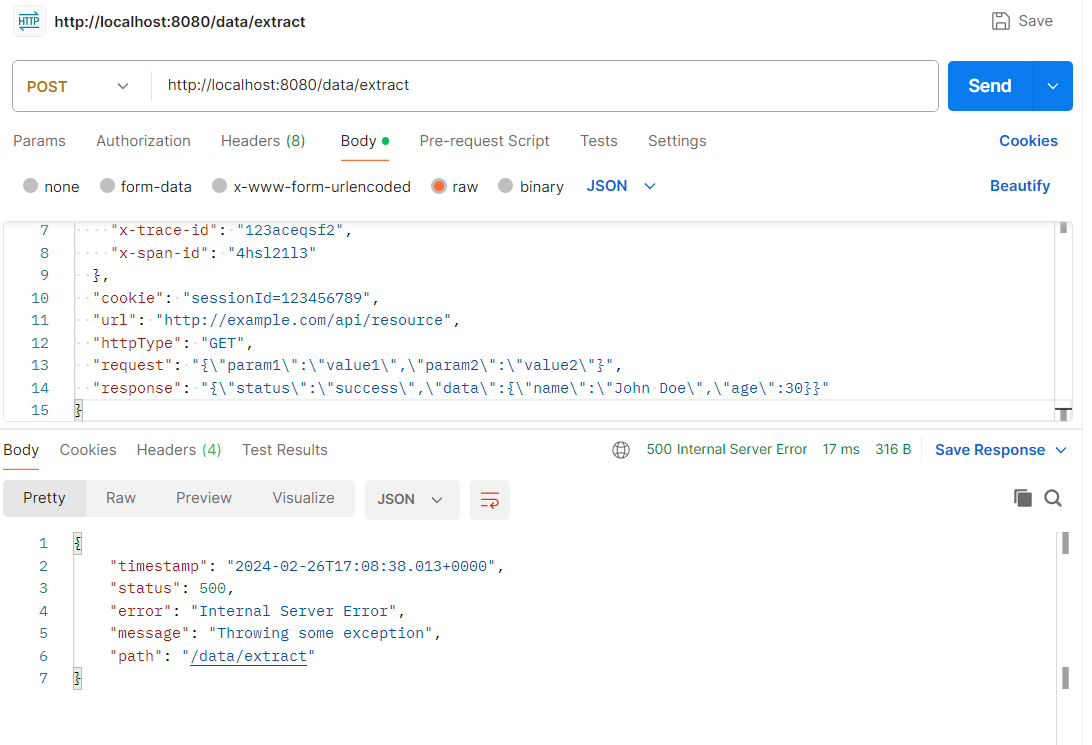
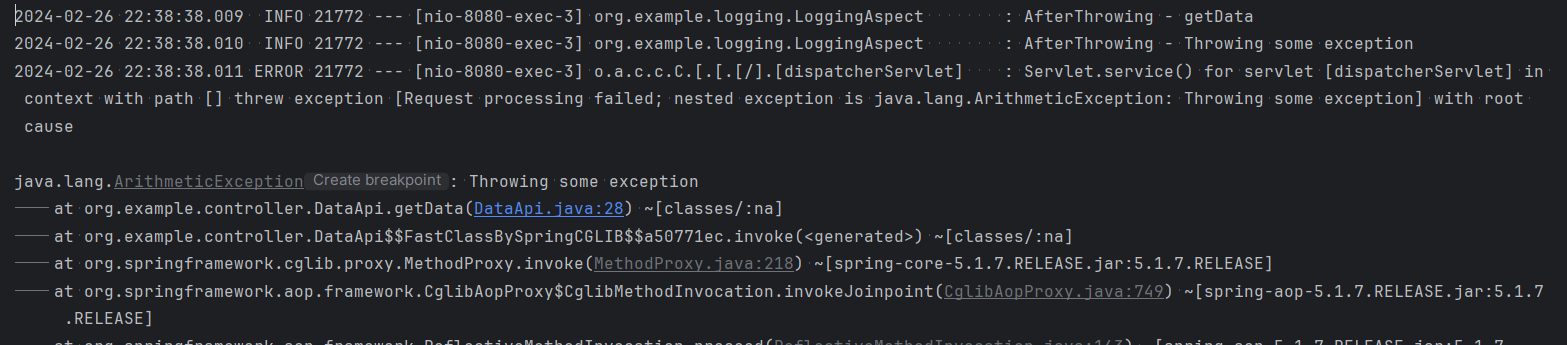
Run the application, trigger the API and observe the logs
Output
{% hint style="info" %}
Note: The code snippet given in this page is just for understanding and does not contain complete code. (For e.g. missing service class code snippet)
{% endhint %}
---
# Agent Instructions
This documentation is published with GitBook. GitBook is the documentation platform designed so that both humans and AI agents can read, navigate, and reason over technical content effectively. Learn more at gitbook.com.
## Querying This Documentation
If you need additional information that is not directly available in this page, you can query the documentation by asking a question.
Perform an HTTP GET request on the following URL with the `ask` and `goal` query parameters:
```
GET https://www.pranaypourkar.co.in/the-programmers-guide/spring/spring-features/spring-aop/after-throwing-advice.md?ask=&goal=
```
`ask` is the immediate question: it should be specific, self-contained, and written in natural language.
`goal` is what the user is ultimately trying to achieve, the reason they need the answer. Sharing it helps GitBook give you a better, more relevant answer. A goal is most helpful when it describes the outcome the user wants rather than restating the question. For example, with `ask=how do I create an API token`, a goal like `automate deployments from our CI pipeline` lets GitBook tailor the answer to that use case.
The response will contain a direct answer to the question and relevant excerpts and sources from the documentation.
Use this mechanism when the answer is not explicitly present in the current page, you need clarification or additional context, or you want to retrieve related documentation sections.